Meet Lizzie Rose
Lizzie Rose is eighteen, a professional dancer, and someone who has never been particularly good at leaving things alone.
Dance has been her life for as long as she can remember. She understands discipline, determination, and the occasional spectacular failure that comes from attempting something her body would rather not do. But there’s a difference between dedicating your life to dance and finding yourself suddenly immersed in the professional world, where everyone seems more experienced, more confident, and altogether more certain they belong.
As the newest member of the Millbrook Contemporary Dance Company, Lizzie is still finding her feet — both literally and figuratively. She’s earned her place, but knowing that and feeling it are two very different things. She sometimes wonders whether the others see her as a genuine colleague or just the promising newcomer who’s still learning how things work. She tries not to let those doubts show, especially when everyone around her seems to know exactly what they’re doing.
One thing Lizzie has never been particularly good at is diplomacy. She tends to say what she thinks, usually without spending much time considering whether it’s what someone wants to hear. She isn’t deliberately trying to offend people; she just doesn’t see the point in wrapping a simple truth in three layers of polite nonsense. Unfortunately, not everyone appreciates this approach. A few people find her refreshing. Others find her exhausting. Lizzie is learning that the professional world has its own rules about what you say, how you say it, and to whom — and that ignoring those rules can have consequences.
She’s also been known to swear when the situation calls for it. Or when it doesn’t, depending on whom you ask. A badly timed expletive isn’t necessarily her first choice of diplomatic tool, but it has been known to slip out before her internal editor gets a vote.
Curious, independent, and occasionally too stubborn for her own good, Lizzie has a habit of asking questions other people would prefer to leave unanswered. She’s still learning how to navigate company politics, professional expectations, and the unspoken rules of a world she’s only recently entered. The last thing she needs is another complication.
Unfortunately, the dead don’t always appreciate being ignored, and some secrets have a way of finding her whether she’s looking for them or not.
Lizzie never set out to become an investigator of the paranormal. She has rehearsals to attend, performances to prepare for, and a career to establish. But when the past begins intruding on the present, she discovers that solving a mystery can require as much patience and precision as learning a complicated dance.
And sometimes, the most dangerous thing you can do is listen when a ghost has something to say.
A Taste of the Mystery
Lizzie Rose knows what it feels like to lose herself in a dance. She’s spent years learning to trust the music, trust her body, and keep going until the movement finally makes sense.
But the Millbrook Theatre has secrets of its own.
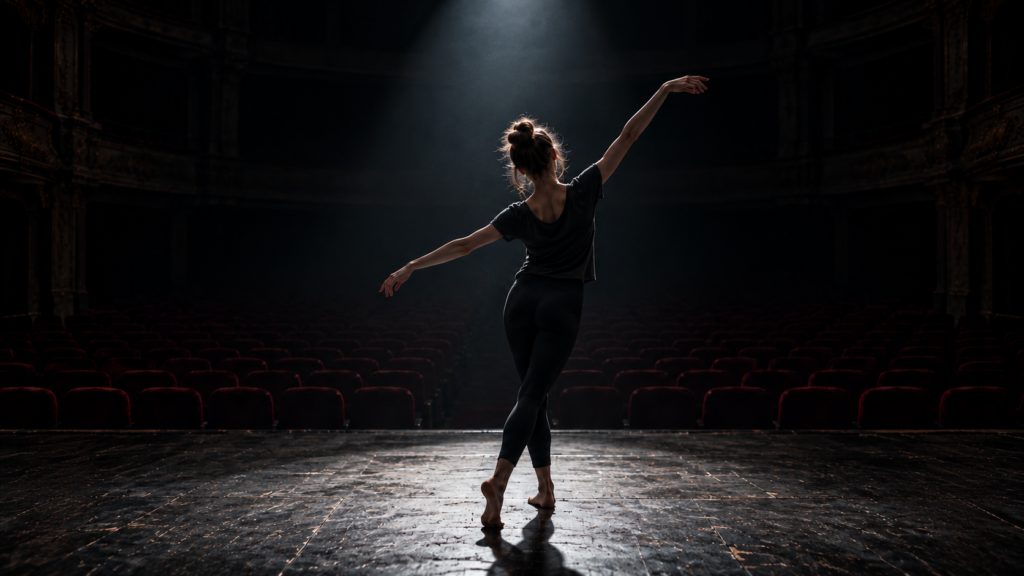
Late one night, while rehearsing alone, Lizzie discovers that sometimes the music doesn’t need a phone, a sound system, or even a living musician to play on.
And that’s when things get interesting.
FREE EXCERPT: Chapter 4
The Millbrook at eleven p.m. was a different proposition entirely.
Lizzie had stayed late before — had lost track of time in studios and rehearsal spaces her whole life, the particular tunnel vision of working something until it clicked — but the Millbrook after hours had a quality the studio never did. The studio was quiet in the way of a place resting. The Millbrook was quiet in the way of a place listening.
She’d stopped noticing it, mostly. That was what eight months did. You built up a tolerance.
She pulled up the music on her phone and set it on the floor at the edge of the stage, propped against her water bottle. Her solo was in Act Two, a six-minute piece that she had technically learned and emotionally not cracked yet, and she knew the difference and it was making her insane.
She shook out her hands. Rolled her neck.
Okay.
The third run was the one. She felt it in the first eight counts — the way the movement stopped being a sequence of things she knew and became something she was actually inside, the feeling she’d been chasing for three weeks, and she didn’t think about it because thinking about it would kill it, she just stayed in it and let the music carry her through the first section into the second and then into the third, the long middle passage that always felt like crossing open water, and she was across it, she was actually across it—
She didn’t notice at first.
That was the thing she’d come back to later, lying awake at two a.m. She didn’t notice because the transition was that clean. The music simply continued, the way music continues, phrase following phrase, and her body followed it the way her body had been following music since she was four years old in Lise’s studio, and nothing told her to stop.
It was her hands that knew first.
Something shifted in what her arms were doing — not a choice, just a response to what the music was asking — and some part of her brain flagged it distantly, the way you flag something in your peripheral vision. That’s different. But the music was still moving and she was still moving with it and the difference was — it was—
She stopped.
Stood completely still.
The music kept playing.
It was beautiful.
That was the first thing, and somehow the worst thing, because she hadn’t expected that. She’d expected wrongness — a skip in the track, a malfunction, something she could dismiss. Instead it was beautiful in a way that made her chest do something she didn’t have a name for. Melancholy was the closest word but it wasn’t quite right. It was melancholy the way an unfinished sentence was melancholy. Like something that had been moving toward a conclusion and never arrived.
And it was familiar.
Her phone was still propped against her water bottle at the edge of the stage.
She walked to it. Picked it up. The screen showed her own playlist, paused at the end of the second section, exactly where she’d felt the shift. Timestamp frozen. Not playing.
The music continued anyway.
Lizzie set the phone back down.
She turned and faced the empty theatre — the dark house, the rows of velvet seats receding into nothing, the ring of painted Muses on the ceiling half-visible above the light line — and she listened. She made herself listen. It cost her something to stand still in that dark and not move toward the exit, and she paid it, and she stood there until the piece reached what she already somehow knew was the end.
Except it didn’t end.
It stopped. Mid-phrase. The way a record stops. The way a breath stops.
The silence that followed was total and immediate, the specific silence of something interrupted rather than completed.
Then, after a moment that lasted longer than it had any right to, her own music resumed. Right where she’d left it. Picking up mid-count as if nothing had happened.
Lizzie stood very still for another few seconds.
Then she picked up her phone, picked up her bag, walked to the wings, and turned off the sound system at the panel. She did these things in the order she always did them. She did not hurry.
She walked up the aisle through the dark house toward the exit, and she did not look back at the stage, because she had a policy about that too.
The policy was: you don’t look back at things that want you to look back.
She pushed through the door into the cold night air and stood on the pavement outside the Millbrook and breathed.
Her hands were shaking. She noticed this with a kind of detached interest, the way you notice weather.
Well, she thought.
Shit.
The Millbrook Haunting is the first book in the Lizzie Rose Mysteries.
The music is only the beginning.